Last week someone in e-commerce told me he had been typing Chinese on the chat page for a long time and the AI never answered a word. The cause was a missing API key.
AI chat with no large model accepts only two English lines: list workflows and run plus a workflow ID. Everything else is ignored. To direct the phone in Chinese, add a large model in model settings first. DeepSeek and OpenAI both work. From 10.6.0 (2026-09-02), this product is called iEasyRun, at https://ieasyrun.com .
Four areas on screen, three steps to start
Open the AI agent and it lands on the AI chat page. The screen has four areas:
| Area | What is there |
|---|---|
| Top toolbar | Connection status, model settings, session history, task panel, settings, workflow editor, new session, CLI/MCP integration |
| Left | Device selection plus the workflow library (a card list you can run and edit) |
| Middle | Chat history, with several conversation tabs (each tab can use its own model) |
| Bottom | The input box. With a large model configured, you can pick which model this session uses |
The top switches between Chat and Workflow editor. One-off requests use chat. Flows you will run again use the editor.
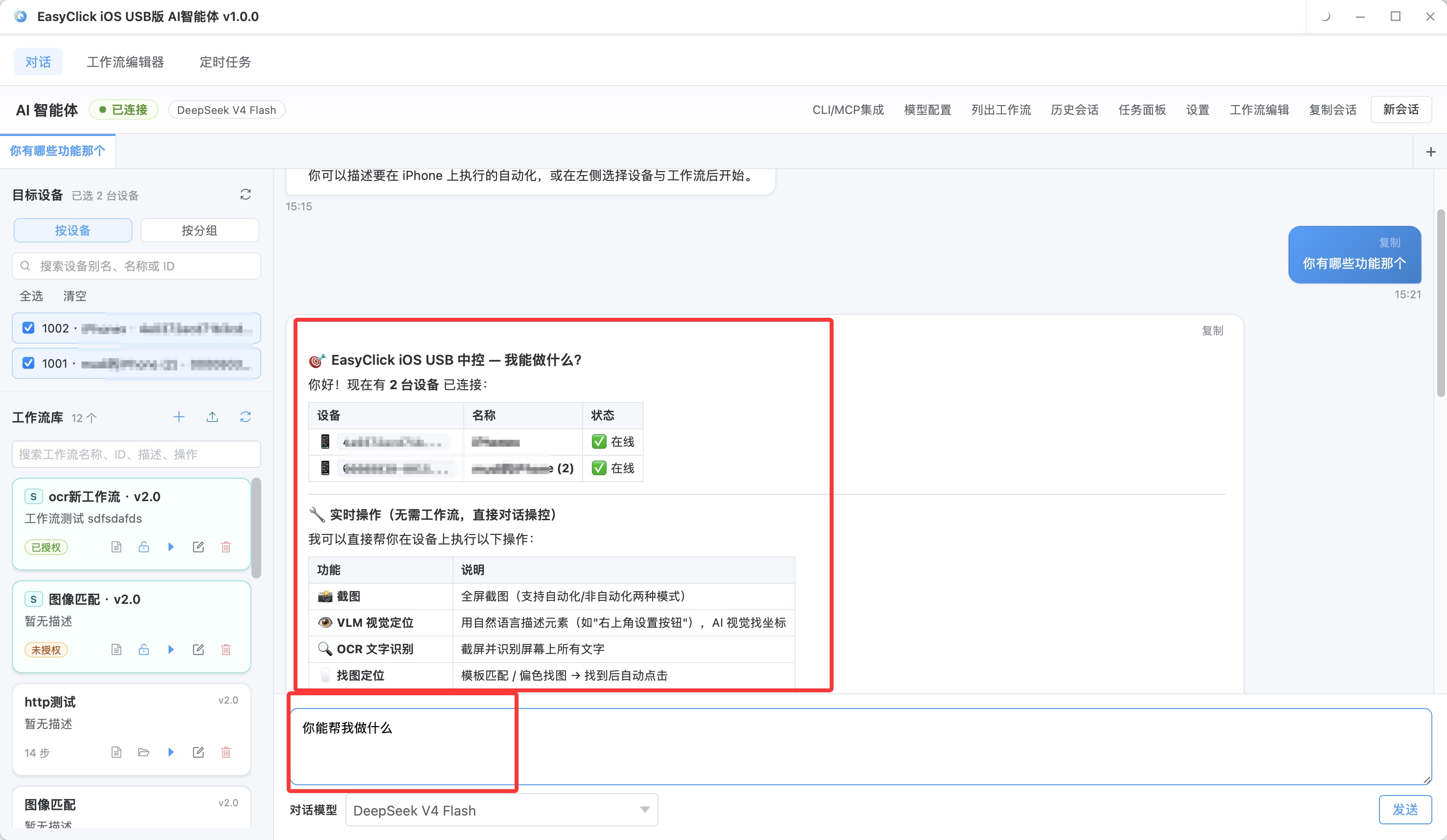
The picture above is the chat window. Check devices on the left, read the chat in the middle, type at the bottom.
Three steps get it running. Check a device on the left. If none is checked, the AI asks which phone to use. Describe the request in Chinese in the input box. Enter sends it. Shift + Enter inserts a line break. When something needs to run, a task is created automatically. Open the task panel for progress.
Taps, screenshots, and workflow runs in chat depend on USB device authorization and the runtime. The AI agent needs USB device authorization. USB mirroring authorization is for mirroring and for operating the UI with a mouse. The phone needs the automation-service IPA installed and signed. On iOS 15 and later you can also use offline main program v7.2.0 or newer as the automation service. The download page has a pre-signed IPA. Screenshot without automation and OCR without automation do not require the automation environment to be started first.
Screenshots, OCR, and image search: how the phrases differ
Chat maps ordinary language onto automation capabilities that already exist. AI chat and the workflow editor use the same capability names:
| Phrase | Meaning | Automation required |
|---|---|---|
| Screenshot without automation | Bridge captures the full screen directly | No |
| Screenshot with automation | Agent service captures the full screen | Yes |
| OCR without automation | Bridge capture plus text recognition | No |
| OCR with automation | Agent capture plus text recognition | Yes |
| Image search without automation / image search with automation | OpenCV template matching | Depends on the environment |
| Color-shift image search without automation / color-shift image search with automation | Match a transparent or color-shifted small image | Depends on the environment |
The basic lines are short: “Open Safari on the first phone”, “Which automations can run right now?”, “Run the login flow”.
To capture and read text, say “Screenshot without automation, look at the current screen”. The device only needs to be connected. The automation environment can stay off. “Screenshot with automation, save the current screen” needs the automation environment started first. To read text, say “Recognize the text on screen and see whether there is a login button”.
To find an image, say “Image search without automation, use template btn_ok.png to find the button”. The template path has to be ready in advance. Or say “Use visual location to find the settings button in the top right”. That one needs a VLM configured first.
The AI replies in Chinese. When information is missing it asks, and it only names flows that exist.
Template paths, region cropping, and center-point extraction belong in the workflow editor, in Find-image preview. Put fixed icons in a workflow. That is more stable than describing them in chat. Finding a button by looking at the picture is less complete in chat than in the editor.
Two commands with no model, and locking the result into a workflow
The workflow library on the left lists saved main flows. Sub-flows are viewed in the editor. Each card can do this:
| Action | What it does |
|---|---|
| Run | Execute immediately on the selected devices (select a device first) |
| Edit | Open the workflow editor and change it |
| Open folder | Open the directory that holds the flow file (for backup) |
| Delete | Delete this flow |
| New | Create a blank flow |
The search box above filters by name and description. The second time you do the same thing, pull it out of chat and into a workflow.
If the API key is still missing, the chat page accepts only fixed commands:
| Input | Effect |
|---|---|
list workflows |
List every workflow |
run plus a workflow ID |
Run it on the selected devices; a device ID can be included |
The feature set is limited, and it can still run. Chat history is saved automatically, so the next session can continue from history. AI replies appear one character at a time. If you do not want to wait, tap cancel. Each chat tab can use a different model, which makes it easy to compare results. When an execution action fails, confirm USB device authorization and the runtime (automation environment, Bluetooth, or OTG) are both in place.
About EasyClick: A mobile automation script development platform covering three phone ecosystems: Android without root, iOS without jailbreak, and HarmonyOS. It also offers Apple script writing, Apple cluster control, Android cluster control, remote cloud control, and AI phone cluster control. → Explore all products
Ready to build it for real?
Every approach in this article can be built with EasyClick capabilities on iEasyClick — full documentation, developer tools and automation products, free to try.